 02 February 2026
From Trial to Table: A Practical Guide to Testing Saffron at Home
Saffron cultivation is often perceived as high-risk, land-intensive, and suited only to traditional farming regions. In reality, the first and most important step in saffron growing is not scale, but validation.
A small, controlled home trial allows growers to understand saffron’s growth cycle, handling requirements, and quality parameters before committing significant time or investment. This guide outlines a realistic, step-by-step approach to testing saffron indoors, focusing on learning outcomes rather than yield volume.
What a Home Trial Is (and Is Not)
A home saffron trial is not a production farm. It is an experiment designed to answer three basic questions:
- Will the bulbs flower under controlled conditions?
- Is the resulting saffron of acceptable quality?
- Can the process be repeated consistently?
By keeping expectations modest and measurements clear, home trials reduce uncertainty and prevent costly mistakes later.
A Realistic 8-12 Week Trial Timeline
A typical indoor saffron trial fits within an 8-12 week window, depending on bulb condition and environmental control.
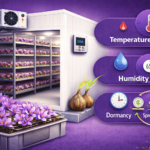
The process begins with bulb preparation. After harvest, saffron bulbs require a dry dormancy period. If bulbs are freshly harvested, they may need to be stored in warm, dry conditions before induction begins. Skipping this step often results in leaf growth without flowering.
Once dormancy is complete, bulbs are moved into the controlled setup for induction. Temperature stability and restrained moisture are critical at this stage. Over-watering is the most common cause of trial failure. Under stable indoor conditions, sprouting and flower initiation are often observed within 7-8 weeks.
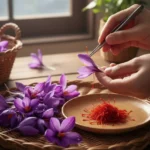
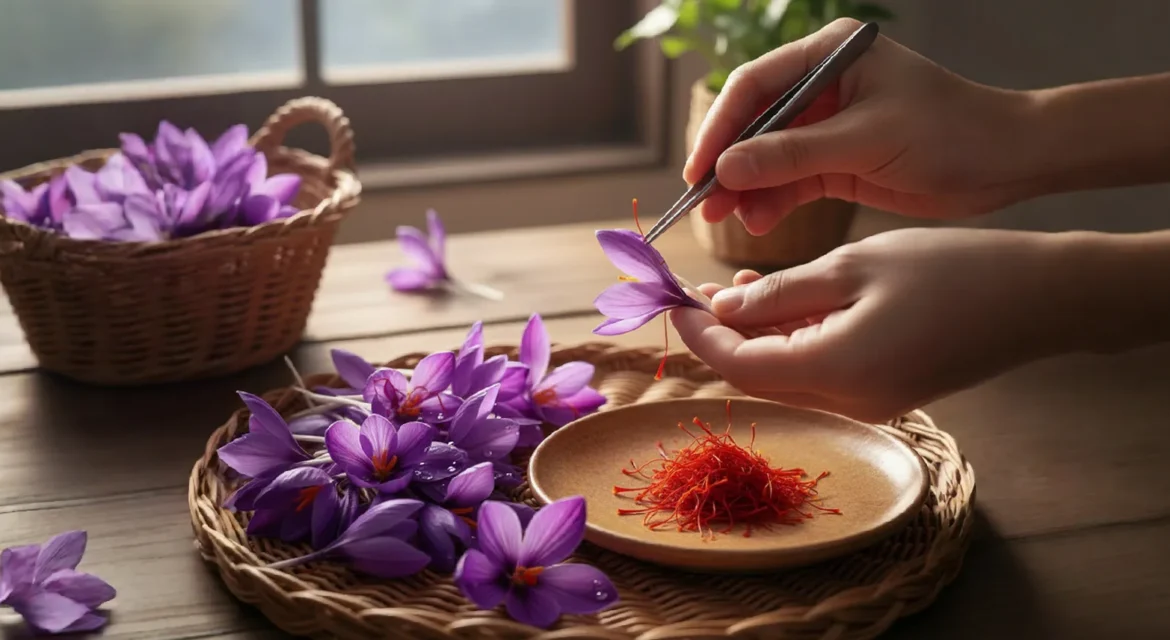
Flowering occurs in a short and predictable window lasting 15-20 days. Flowers must be monitored daily and harvested promptly. Each flower produces exactly three red stigmas, which form the usable saffron threads.
After harvest, stigmas must be dried carefully and stored correctly. Drying speed and moisture control directly affect color strength and aroma-key quality indicators.
What to Measure During the Trial
A home trial should focus on process validation, not total output. Three measurements are sufficient to evaluate success:
- Flowering rate: the percentage of bulbs that produced flowers
- Yield per bulb: grams of dried saffron per flowering bulb
- Strand quality: visual color intensity and aroma retention
These metrics provide a clear picture of whether conditions were suitable and whether the process is repeatable.
Common Mistakes That Undermine Trials
Most unsuccessful trials fail for predictable reasons. These include:
- Incomplete dormancy before induction
- Excess moisture during sprouting
- Poor airflow leading to fungal stress
- Delayed harvesting during flowering
- Inadequate drying or improper storage
Importantly, minor temperature deviations are rarely the primary cause of failure. Handling and timing errors matter far more.
Why Small Trials Create Better Growers
Home trials offer more than just technical insight. They build practical skills-harvesting delicacy, drying judgment, and observation discipline-that cannot be learned from theory alone.
They also encourage evidence-based decisions. Rather than investing upfront in land, infrastructure, or large bulb quantities, growers can assess viability using real data from their own environment.
This approach is especially valuable in urban or non-traditional growing regions, where outdoor cultivation carries higher uncertainty.
What Comes After a Successful Trial
If a trial produces consistent flowering and acceptable quality, the next step is not immediate scale. Repeating the trial helps confirm reliability.
Only after consistency is demonstrated should growers consider:
- Bulb multiplication using soil-based grow bags
- Larger controlled spaces
- Advanced environmental optimization
Each step builds on validated results rather than assumptions.
Practical Takeaways
- Home trials are about learning, not production
- Controlled environments reduce uncertainty
- Measurement matters more than scale
- Repetition confirms reliability
Conclusion
Testing saffron at home is the most practical way to understand whether cultivation is feasible before committing resources. A small, disciplined trial reveals far more than large, untested investments ever could.
By focusing on validation, observation, and repeatability, growers gain clarity. And in saffron cultivation, clarity is the most valuable outcome of all.