 02 February 2026
The Science & Practical Steps Behind Successful Indoor Trials
Saffron has long been associated with specific geographies such as Kashmir and parts of Iran. This has led to the assumption that saffron cultivation is inherently tied to location. In reality, saffron responds not to geography, but to environmental triggers.
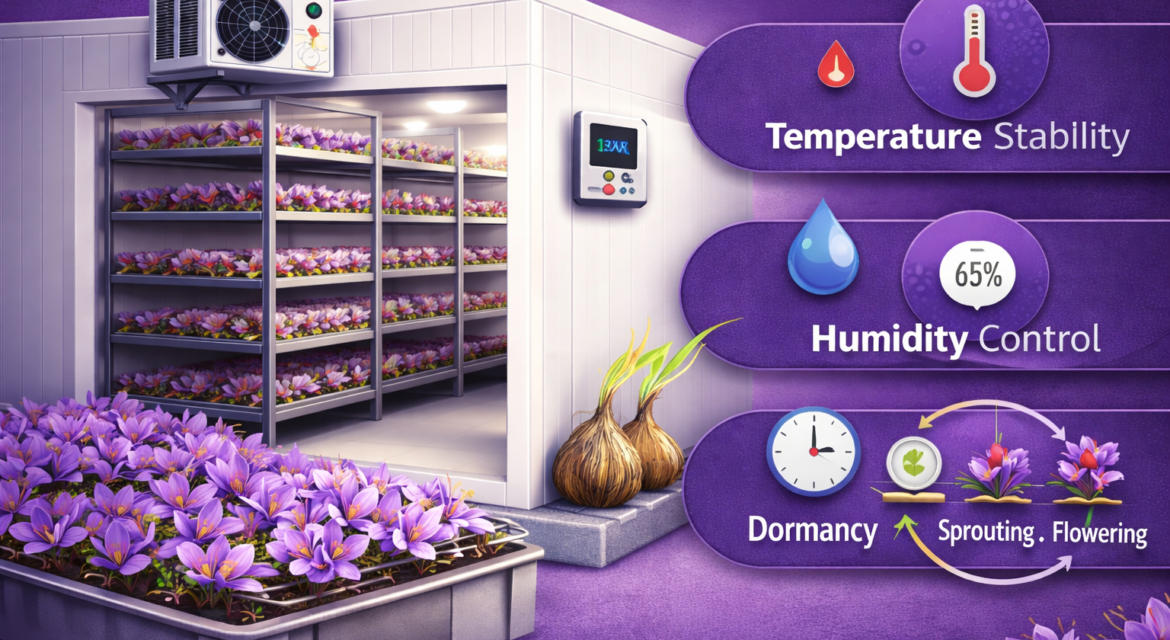
When these triggers-temperature, humidity, and dormancy cycles-are recreated accurately, saffron can be grown far beyond its traditional regions. This is the scientific basis behind indoor saffron trials.
This article explains why controlled indoor cultivation works, what actually governs saffron flowering, and why small trials are the most reliable way to validate cultivation before scaling.
What Saffron Really Needs to Flower
Saffron (Crocus sativus) is a bulbous perennial with a discontinuous growth cycle. It does not grow year-round. Instead, it progresses through dormancy, induction, flowering, and recovery, each phase triggered by specific environmental conditions.
Dormancy is the foundation. After harvest, bulbs must remain dry and warm for several weeks. During this phase, internal floral development occurs even though nothing is visible externally. Training-based protocols commonly reference dormancy storage around 25°C with moderate humidity, emphasizing dryness over irrigation.
Once dormancy is complete, a controlled shift in temperature and humidity initiates sprouting and flowering. This induction phase is highly sensitive. Inconsistent moisture or temperature fluctuations often result in leaf growth without flowers-one of the most common beginner mistakes.
In stable indoor trials, sprouting and bud initiation are typically observed within 7-8 weeks after induction begins, provided conditions remain consistent.
The Narrow Flowering Window
Saffron flowering is brief but predictable. The flowering window typically lasts 15-20 days, during which flowers must be harvested daily.
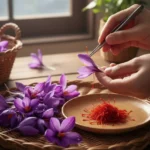
Each flower produces exactly three red stigmas, which form the usable saffron threads. Delayed harvesting reduces color intensity and aroma, directly impacting quality. Because flowering is time-bound and manual, consistent monitoring during this period is essential.
Indoor environments offer a key advantage here: they reduce external disruptions such as rain, wind, pests, and temperature swings that commonly interfere with outdoor flowering.
Why Indoor Trials Are Reliable
Indoor trials work because they eliminate the largest sources of uncertainty in saffron cultivation. Weather variability, irregular rainfall, soil-borne disease, and pest pressure are largely removed.
More importantly, controlled environments allow growers to observe cause-and-effect relationships. When flowering occurs-or fails to occur-the reasons are measurable and correctable.
This makes indoor trials ideal for validation rather than production. They allow growers to understand bulb quality, refine handling practices, and test drying methods without committing land or large capital.
What to Measure (and What Actually Matters)
Successful trials focus on a small number of meaningful indicators rather than total output.
Key metrics include:
- Flowering rate: the percentage of bulbs that produce flowers
- Yield per bulb: grams of dried saffron per flowering bulb
- Strand quality: color strength and aroma retention
These metrics reveal far more than total harvest weight. A trial with fewer bulbs but consistent flowering and strong quality is more valuable than a larger but erratic setup.
Common Failure Points in Indoor Cultivation
Most indoor saffron failures trace back to a few avoidable issues:
- Incomplete or rushed dormancy
- Over-watering during induction
- Poor airflow leading to fungal stress
- Delayed harvesting during flowering
- Improper drying and storage
Notably, minor temperature deviations are rarely the main cause of failure; handling errors are.
Why Trials Should Come Before Scaling
Indoor trials reduce uncertainty. They generate real data, build handling experience, and reveal whether a specific bulb batch or setup is worth repeating.
They also help growers decide whether to:
- Repeat trials for consistency
- Move bulbs into soil-based multiplication
- Adjust environmental parameters before expanding
This validation-first approach significantly lowers risk compared to scaling directly into open-field or large infrastructure systems.
Practical Takeaways
- Saffron cultivation depends on environmental control, not geography
- Dormancy and induction are more critical than flowering itself
- Small, controlled trials offer the fastest learning curve
- Measurement and consistency matter more than scale
Conclusion
Belief in indoor saffron cultivation should be grounded in biological understanding and measured results. When dormancy cycles, temperature shifts, and handling practices are managed correctly, saffron flowering becomes repeatable-even indoors.
Controlled trials are not a shortcut; they are a discipline. They provide the clarity needed to decide whether saffron cultivation is viable before committing resources. In a world of climate uncertainty and tightening supply, that clarity has never been more valuable.